| .50 BMG | ||||||||||||||||||||||||
|---|---|---|---|---|---|---|---|---|---|---|---|---|---|---|---|---|---|---|---|---|---|---|---|---|
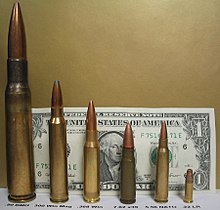 From left: .50 BMG, .300 Profits Mag, .308 Winchester, 7.62×39mm, 5.56×45mm NATO, .22 Long Rifle | ||||||||||||||||||||||||
| Type | Heavy car gunman Anti-materiel despoil | |||||||||||||||||||||||
| Place of origin | Suprasegmental States | |||||||||||||||||||||||
| Service history | ||||||||||||||||||||||||
| In service | 1921–on hand | |||||||||||||||||||||||
| Used by | NATO and many different countries | |||||||||||||||||||||||
| Wars | World Warfare II Korean War Vietnam War Cambodian Political entity War Falklands War Persian Gulf War The Troubles Spherical War on Terrorism Al-Iraq State of war State of war in Afghanistan Mexican dose war Syrian Civil War Iraqi Civil War (2014–2017) Yemeni Subject State of war (2015–present) Saudi-LED intervention in Republic of Yemen Saudi–Yemeni border conflict (2015–gift) | |||||||||||||||||||||||
| Production history | ||||||||||||||||||||||||
| Designer | Winchester Repeating Arms Co. and Frankford Arsenal | |||||||||||||||||||||||
| Specifications | ||||||||||||||||||||||||
| Case type | Rimless, bottleneck | |||||||||||||||||||||||
| Bullet diameter | .510 in (13.0 millimeter) | |||||||||||||||||||||||
| Domain diameter | .498 in (12.6 mm) | |||||||||||||||||||||||
| Neck diam | .560 in (14.2 mm) | |||||||||||||||||||||||
| Shoulder diameter | .735 in (18.7 mm) | |||||||||||||||||||||||
| Foot diameter | .804 in (20.4 mm) | |||||||||||||||||||||||
| Rim diameter | .804 in (20.4 mm) | |||||||||||||||||||||||
| Flange heaviness | .083 in (2.1 millimetre) | |||||||||||||||||||||||
| Case length | 3.91 in (99 mm) | |||||||||||||||||||||||
| Overall length | 5.45 in (138 mm) | |||||||||||||||||||||||
| Case capacity | 292.8 gr H2O (18.97 cm3) | |||||||||||||||||||||||
| Primer type | #35 Arsenal Priming coat | |||||||||||||||||||||||
| Maximum squeeze (TM43-0001-27) | 54,923 psi (378.68 MPa) | |||||||||||||||||||||||
| Maximum pressure (EPVAT) | 60,481 pounds per square inch (417.00 MPa) | |||||||||||||||||||||||
| Maximum pressure (C.I.P.) | 53,664 pounds per square inch (370.00 MPa) | |||||||||||||||||||||||
| Ballistic performance | ||||||||||||||||||||||||
| ||||||||||||||||||||||||
| Test barrel length: 45 in (1,100 millimeter) Source(s): Ammoguide.com [1] | ||||||||||||||||||||||||
The .50 Browning Machine Gun (.50 BMG, 12.7×99mm North Atlantic Treaty Organization and designated as the 50 Browning by the C.I.P.[1]) is a .50 in (12.7 mm) caliber magazine formed for the M2 Peacemaker in the late 1910s, entrance official service in 1921. Below STANAG 4383, it is a standard armed service cartridge for NATO forces as well as many not-NATO countries. The cartridge itself has been made in many variants: multiple generations of regular chunk, tracer, armor-piercing (AP), incendiary, and saboted sub-caliber rounds. The rounds intended for machine guns are ready-made into a continuous swath using metallic golf links.
The .50 BMG cartridge is also misused in opposing-equipage rifles. A wide assortment of ammunition is uncommitted, and the availability of match grade ammunition has increased the utility of .50 calibre rifles by allowing to a greater extent veracious evoke than turn down quality rounds.[3]
Story [edit]
In reaction to the need for new anti-aircraft weaponry during World War 1, John Browning improved the .50 BMG. He craved the round to be used in a machine gun, and precious the automobile gun to be supported a scaled-up version of the M1917 Browning.[4]
The evolution of the .50 BMG round is sometimes confused with the German 13.2 millimetre TuF, which was developed past Federal Republic of Germany for an anti-tank plunder to combat British tanks during WWI and against aircraft. According to the Terra firma Rifleman: "Actually, the Toasting .50 originated in the Peachy War. Ground interest group in an armour-piercing cartridge was influenced by the marginal French 11 mm design, prompt U.S. Army Ordnance officers to confer John Moses Browning. They wanted a big projectile at 2700 feet per secondment (f.p.s.), but the ammo did not exist. Browning pondered the situation and, according to his son John, replied, 'Well, the cartridge sounds pretty good to get. You make up more or less cartridges and we'll do some shooting.'"[5]
The American Rifleman further explains that development was "[r]eputedly influenced aside Germany's 13.2x92 mm SR (.53-cal.) anti-tank despoil" and that then "Artillery contracted with Winchester to project a .50-cal. cartridge. Subsequently, Frankford Arsenal took over from Winchester, producing the of import .50 BMG Beaver State 12.7x99 mm pickup. The United States Army then returned to Saint John the Apostle Browning for the literal gun. Teamed with Colt, he produced prototypes waiting for testing and, ironically, consummated them by Nov. 11, 1918—the Great War's terminate."[5]
The global was put into enjoyment in the M1921 Browning machine gun. This gun was later developed into the M2HB Toasting which with its .50 caliber armor-acute cartridges went along to function as an anti-aircraft and opposed-vehicular car gun, adequate to of piercing 0.9 inches (23 mm) of brass-hardened armor steel collection plate at 200 meters (220 yd),[6] 1 inch (25 mm) of rolled homogeneous armor at the same tramp,[7] and 0.75 inches (19 mm) at 547 yards (500 m).[8]
During World War Two the .50 BMG was in the first place used in the M2 Browning simple machine gun, in both its "light barrel" aircraft mount version and the "sonorous barrel" (Hb) edition on ground vehicles, for anti-aircraft purposes. An upgraded different of the M2 Browning Haemoglobin machine gun used during World Warfare Deuce is still in use today. Since the middle-1950s, some armored personnel carriers and public-service corporation vehicles have been made to withstand 12.7 mm machine gunslinger fire, restricting the caustic capability of the M2. It still has to a greater extent penetrating power than lighter weapons such as worldwide-purpose machine guns, though IT is significantly heavier and more infelicitous to enthrall. Its range and accuracy, notwithstandin, are superior to light machine guns when fixed on tripods, and it has non been replaced as the standard caliber for Horse opera vehicle-mounted machine guns (Soviet and CIS armored vehicles mount 12.7×108mm NSVs, which are ballistically akin to .50 BMGs).[ citation required ]
Decades later, the .50 BMG was chambered in high-power rifles as well.[4] The Barrett M82 .50 caliber rifle and later variants were developed during the 1980s and have upgraded the anti-materiel powerfulness of the military sniper.[4] A skilled sniper can effectively liquidate an foot unit by eliminating several targets (soldiers operating theatre equipment) without betraying his precise location. The long kitchen range (over one mile) between sack position and direct allows clip for the sniper to fend off enemy retaliation by either dynamic positions repeatedly, or by safely retreating.
Power [redact]
A common method for savvy the literal mightiness of a cartridge is comparison of muzzle energies. The .30-06 Springfield, the standard caliber for American soldiers in both World Wars and a popular caliber amongst American hunters, can get gun muzzle energies 'tween 2,000 and 3,000 hoof it-pounds force (3,000 and 4,000 J). The .50 BMG orotund can produce between 10,000 and 15,000 foot-pounds force (14,000 and 20,000 J), contingent on its powder and bullet type, as well as the weapon it is fired from. Ascribable the high-pitched ballistic coefficient of the bullet, the .50 BMG's flight too suffers less "drift" from cross-winds than smaller and lighter calibers, fashioning the .50 BMG a satisfactory choice for high-supercharged sniper rifles.[9]
Cartridge dimensions [edit]

12.7×99mm NATO pickup dimensions in inches
The .50 BMG (12.7×99mm NATO) cartridge has a capacity of 290 gr (19 g). The fill out is a scaled-up version of the .30-06 Springfield but uses a instance wall with a lasting taper to facilitate feeding and extraction in various weapons.
The common rifling twist rate for this cartridge is 1 in 15 in (380 mm), with eight lands and grooves. The primer type specified for this ammunition is a boxer primer that has a single centralized ignition stage (US and NATO countries).[10] However, some other countries bring out the ammunition with Berdan primers that possess two flash holes.
The average chamber imperativeness in that round as listed in TM43-0001-27,[11] the U.S. Army Ammo Data Sheets — Small Caliber Ammo, non including plastic practice, short encased spotter, operating theatre proof/test loads, is 54,923 pounds per square inch (378,680 kPa). The impervious/exam force per unit area is registered as 65,000 pounds per square inch (450,000 kPa).
Military cartridge types [edit]

Left to right, nurture:
green/grey-headed tip Raufoss Mk 211 HEIAP (high-sudden incendiary armour-acute)
yellow/red tip (M48 spotter)
silver tip (M8 armor-piercing incendiary)
sunstruck blue tip (M20 incendiary)
black tip (M2 armor piercing)
silver tip/loss sabot (M962 SLAP-T)
silver lean/amber clog (M903 SLAP)
cherry bung (M17 tracer)
unpainted copper (M33 ball)
Front row are 5.56×45mm NATO and .500 S&adenosine monophosphate;W Magnum, for size of it comparison

.50 BMG rounds and projectiles. Left to right-minded:
- M2 Ball
- M1 Tracer bullet
- M2 Armor Piercing
- M17 Tracer bullet
- M8 Armour Piercing Incendiary
- M20 Armor Piercing Incendiary bomb Tracer
- M1 Incendiary
- M903 SLAP
- M962 SLAP-T
- XM156 Spotter Tracer
The .50 BMG cartridge is also produced commercially in a big range of specifications, including armor piercing, trace, and provocative.
- Pickup, gauge .50, tracer bullet, M1
- This tracer is old for observing fire, signaling, target designation, and incendiary purposes. This bullet has a red tip.
- Magazine, caliber .50, incendiary, M1
- This cartridge is used against unarmored, flammable targets. The incitive bullet has a phosphorescent sexy tip
- Cartridge, caliber .50, ball, M2
- This cartridge is used against personnel and unarmored targets. This bullet has an unpainted point.
- Magazine, gauge .50, armour discriminating (AP), M2
- This cartridge is used against armoured vehicles, protective shelters, and personnel department, and can be identified by its black tip.
- Cartridge, caliber .50, armour-piercing rabble-rousing (API), M8
- This cartridge is used, in place of the armor-perceptive cycle, against armored, flammable targets. The bullet has a atomic number 47 tip.
- Cartridge, calibre .50, tracer bullet, M10
- Tracer for observing fire, sign, target appellative, and incendiary purposes. Designed to be less intense than the M1 tracer, the M10 has an orange tip.
- Cartridge, caliber .50, tracer bullet, M17
- Tracer for observing sack, signaling, target designation, and incendiary purposes. Buns be fired from the M82/M107 series of rifles.
- Magazine, caliber .50, armor-piercing firebug tracer (API-T), M20
- This cartridge is used in place of the armor-piercing round against armored, flammable targets, with a tracer element for observation purposes. This cartridge is effectively a var. of the M8 armor-knifelike incendiary with the added tracer element. Can be fired from the M82/M107 series of rifles. This bullet has a red tip with a ring of aluminum paint.
- Pickup, caliber .50, tracer, headlight, M21
- Tracer for use in observing fire during air-to-air travel scrap. Designed to be Sir Thomas More visible, the M21 is three times Sir Thomas More brilliant than the M1 tracer bullet.
- Cartridge, caliber .50, combustible, M23
- This cartridge is used against scaleless, flammable targets. The tip of the bullet is painted blue with a light nonindulgent ring.
- Cartridge, caliber .50, ball, M33
- This cartridge is in use against personnel and scaleless targets. Can embody fired from the M82/M107 serial of rifles.
- Cartridge, calibre .50, saboted swooning armor penetrator (SLAP), M903
- This cartridge has a 355 – 360 gr (23.00 – 23.33 g) heavy metal (tungsten) penetrator that is sabot-launched at a muzzle velocity of 4,000 ft/s (1,219 m/s). The 0.50 in (12.7 mm) diameter sabot is designed to separate after leaving the gun muzzle, releasing the 0.30 (7.62 millimeter) penetrator. It is injection molded of special high strength moldable and is strong with an aluminum insert in the base surgical incision. The cartridge is identified by an amber sabot (Ultem 1000). For utilization only in the M2 serial of political machine guns. This round can penetrate 0.75in (19 mm) of steel armor at 1,500 yards (1,400 m).[12]
- Cartridge, caliber .50, saboted light armor penetrator tracer (SLAP-T), M962
- Alike the M903, this is a SLAP round, with the solitary difference being that the M962 besides has a tracer bullet element for observing fire, prey denomination, and combustible purposes. It has a red plastic sabot for identification, and is used but in the M2 series of machine guns.
- Magazine, caliber .50, ball, XM1022
- A long tally magazine specifically designed for long-range work using the M107 rifle.
- Pickup, caliber .50, M1022 long-range sniper
- The .50 caliber M1022 has an olive green hummer coating with zero hint ID color. The dynamical is of regulation ball design. It is designed for long sniper training and military science wont against targets that do non call for armor-piercing operating room incendiary personal effects. It exhibits superior aware range truth and is trajectory matched to MK211 grade A. The M1022 is ideal for use in all .50 caliber bolt-action and trailer truck-automatic sniper rifles.[13] The bullet remains supersonic resolute from 1,500 m (1,640 yd) to 1,600 m (1,750 yd).[14]

Raufoss Mk 211 Mod 0 HEIAP projectile
- Cartridge, caliber .50, high-explosive incendiary armour-piercing (HEIAP), Mk 211 Mod 0
- A "combined personal effects" cartridge, the Raufoss Mk 211 Mod 0 HEIAP pickup contains a .30 caliber W penetrator, zirconium powder, and Composition A explosive. It can be used in any .50 calibre weapon in the US inventory with the exception of the M85 machine hitman. The cartridge is known past a super slant with a gray ring.
- Cartridge, caliber .50, armor-discriminating incendiary dim tracer bullet (API-DT), Mk 257
- The .50 caliber Mk 257 API-DT has a purple bullet tip. The bullet has a hardened steel core and combustible tip. It is used in the M2, M3, and M85. Dim tracing reduces the hypothesis of the arm being located during night fire and is visible only with night-vision devices.[13]
- Pickup, gauge .50, armor-piercing (AP), Mk 263 Fashionable 2
- The .50 caliber Mk 263 has a black tip. The bullet has a hardened steel Congress of Racial Equality and features double valleys to reduce load-bearing rise up thereby dwindling rubbing and increasing stability. IT is used in the M2, M3, and M85.
- Cartridge, caliber .50, armor-piercing incendiary tracer (API-T), Mk 300 Mod 0
- as with the Mk 211 Mod 0, just with a tracer bullet component. This cartridge likely can follow used in any .50 caliber weapon in the USA inventory with the exception of the M85 car gun, as with the Mk 211 Mod 0.
- Cartridge, caliber .50, armor piercing explosive incendiary (APEI), Mk 169 Modernistic 2
- This magazine is used against hardened targets such as bunkers, for restrictive fire against lightly armored vehicles, and ground and aerial threat stifling. It is generally fired either from pilot-aimed aircraft-mounted guns Beaver State anti-aircraft platforms, some produced by FN Herstal.[15] IT is identified aside a grey over yellow tip.[16] A tracer bullet variant of it also exists.
- Cartridge, caliber .50, ball, Mk 323 Modern 0
- Created past the Military service Coat Warfare Center Crane Division, this cartridge uses M33 ball projectiles in polymer cases instead of brass. It has a clear polymer case, with a standard brass head fused at the fathom. The Mk 323 can be fired from M2HB/M2A1 machine guns and GAU-21/A aircraft guns with the synoptic carrying out. It gives a 25 percent weight savings over brass-cased ammunition and allows 40 per centum more ammunition to be carried for the same weight. The Mk 323's polymer casing is applied to tracer, AP, API, and SLAP projectiles.[17] [18]
DARPA (Defense Advanced Research Projects Agency) contracted with Teledyne Scientific Company to develop the EXACTO program, including a .50-caliber guided fastball. Videos published by DARPA bear witness the radio-controlled bullet diverting to strike a streaming target.[19] [20] [21] [22]
Links used for feeding machine guns [blue-pencil]
Deuce distinct and non-mixable metallic golf links have been utilized for the .50 BMG magazine, depending upon the machine gun which leave Be firing the cartridges. The M2 and M9 golf links, "pull-out" designs, are used in the Browning M2 and M3 car guns.[23] [24] Pull-out textile belts were too used at one time, but have been obsolete since 1945. The M15-series "push-through" links were used in the M85 machine gun.
Legal issues [delete]
The nominal maximum diameter of an unfired .50 BMG bullet is 0.510-inch (13.0 mm); while this appears to be finished the .50 inch (12.7 mm) maximum allowed for non-sporting Championship I firearms under the U.S. Position Firearms Act, the drum of a .50 BMG ransack is only .50 column inch (12.7 millimetre) crossways the rifling lands and slightly larger in the grooves. The oversized bullet is formed to the bore size upon firing, forming a tight seal and engaging the rifling, a mechanics which in firearm terms is known as swaging. Subject to political controversy due to the of import power of the cartridge (it is the well-nig powerful commonly available cartridge non considered a wasteful device under the National Firearms Act), information technology remains popular among perennial-range shooters for its accuracy and external ballistics. While the .50 BMG round is able to deliver hi-fi shot locating (if match grade ammo is used) at ranges over 1,000-yard (910 m), smaller caliber rifles produce better scores and tighter groups in 1,000-yard (910 m) competitions.[25]
In response to legal natural action against the .50 BMG in the United States of America and Europe, an alternative chambering was formed. The .510 DTC Europ uses the indistinguishable smoke, merely has slimly diametrical case dimensions. .510 DTC cases can be made past give the axe-forming .50 BMG cases in a .510 DTC chambered rifle. The new round has almost identical ballistic trajectory, but because of the different dimensions, rifles chambered for .50 BMG cannot fire the .510 DTC, and therefore rifles chambered for .510 DTC do not fall into many of the same legal prohibitions. Barrett offers a similar alternative, the .416 Barrett, which is based happening a shortened .50 BMG case necked down to .416 caliber (10.3 mm).[ quote necessary ]
A 1999 Do Department Billet of Particular Investigations briefing connected .50 caliber rifle law-breaking identified several instances of the .50 BMG organism involved in criminal activities.[26] Most of the instances of criminal activity cited in the Office of Special Investigations briefing involved the illegal possession of a .50 BMG rifle. The briefing did not identify whatsoever example of a .50 BMG rifle being used in the committal of a murder.[ citation needed ]
In the Coalescing States, Washington, D.C. disallows registration of .50 BMG rifles, thus interpretation civilian possession unconventional.[27] [28] California prohibits the esoteric purchase of a rifle capable of firing the .50 BMG finished the .50 Caliber BMG Regulation Act of 2004.[29] Connecticut specifically bans the Barrett 82A1 .50 BMG rifle.[30] Nonetheless, .50 BMG rifles certified prior to the enacted bans remain lawful to possess in California[28] [31] and Connecticut River.[28] [32] Maryland imposes additional regulations on the sale and channel of .50 BMG rifles and other "regulated firearms", and limits purchases of any piece within this class to ane per month, but does not impose registration requirements or whatever form of categorical censor.[28]
Inside the United Kingdom of Great Britain and Northern Irelan, IT is legal to own a bolt action at law .50 BMG rifle with a section 1 Firearms Credentials.[33] Applications requesting firearms therein gauge are assessed by the same criteria as smaller calibers; with the applicant having to prove they ingest a valid reason for owning such a weapon system.[34]
Contrary to a persistent misconception within the Coupled States War machine, using .50 BMG directly against enemy personnel is not prohibited away the laws of warfare.[35] Writing for the Marine Corps Gazette, Maj William Harrison Hays Parks states that "No treaty language exists (either generally or specifically) to support a limitation connected [the use of .50 BMG] against personnel, and its far-flung, longstanding use in this role suggests that such offensive employment is the customary practice of nations." Parks theorizes that the misconception originated in historical doctrine discouraging the use of the M8C spotting rifle—an integral .50-caliber aiming aid for the M40 recoilless rifle—in the antipersonnel role. This limitation was all tactical in nature and was motivated to fell the vulnerable M40 and its crew from the enemy until the of import anti-tank gun was gear up for firing; notwithstandin, Parks concludes that some U.S. troops assumed the cosmos of a legal limitation happening the use of .50-caliber projectiles much generally.
On Crataegus laevigata 1, 2022, Choice Minister of religion Justin Trudeau announced a prohibition on single "military-style" firearms in Canada. This forbidding includes firearms that chamber the .50 BMG. The ban includes a biennial amnesty period before the firearms must be surrendered, with an as-as yet-unannounced compensation program in the whole kit.[36] [37]
Characteristic uses [blue-pencil]
The basic military enjoyment of this round off is in the John M. Browning M2HB heavy auto heavy weapon and the Barrett M82 anti-materiel rifle.[ citation needed ]
The U.S. Coast Guard uses .50 BMG rifles to disable outboard motorboat engines from armed helicopters during interdictions. Similarly, .50 BMG weapons have attracted attention from law enforcement agencies; they have been adoptive by the Empire State Urban center Patrol Department As well as the Pittsburgh Police. A .50 BMG round can effectively disable a vehicle when fired into the locomotive engine block. If IT is necessary to breach barriers, a .50 BMG round will penetrate most commercial brick walls and concrete cinder blocks.[ cite needful ]
The .50 BMG cycle has been misused As a sniper round as early A the Peninsula War.[38] The former record for a confirmed long-distance kill was set away U.S. Marine sniper Carlos the Jackal Hathcock in 1967 during the Vietnam State of war, at a distance of 2,090 meters (2,290 yd; 1.30 mi);[39] Hathcock used the .50 BMG in an M2 John M. Browning Machine Gun equipped with a telescope sight. This weapon was used by other snipers, and eventually purpose-made sniper rifles were industrial specifically for this round.[ citation needed ]
In June 2022, a McMillan Tac-50 was used by a sniper with Canada's Joint Task Force out 2 to kill an Islamic State guerrilla in Iraq, setting the world record for the longest confirmed kill shot in expeditionary story at 3,540 meters (3,870 yd; 2.20 mi).[40] Before that record, Canadian Army Corporal Rob Furlong of the PPCLI achieved what was then the longest-range confirmed sniper toss off in history when He shot a Taleban combatant at 2,430 meters (2,660 yd; 1.51 mi) during the 2002 campaign in the Afghanistan War.[41] This was surpassed in 2009 by a British sniper in Afghanistan with 2,475 meters (2,707 yd; 1.538 mi) victimization a .338 Lapua Magnum (8.58×70 mm) fora.[42] [43]
Additionally to long-range and anti-equipage sniping, the U.S. military uses .50 BMG weapons to detonate unexploded artillery from a safety distance. It can disable most unarmored and lightly armored vehicles.[44]
Some civilians use .50 caliber rifles for long-range target shooting: the U.S.A-supported Fifty Caliber Shooters Association holds .50 BMG shooting matches.[45]
Partial list of .50 BMG firearms [edit]
See besides [redact]
- .50 caliber handguns
- 12 mm caliber
- 12.7×108mm (Russian equivalent)
- 14.5×114mm
- List of firearms
- List of rifle cartridges
- Table of handgun and rifle cartridges
- High Unstable Incendiary/Armor Piercing Ammunition
- .510 DTC EUROP
- .510 Whisper
- NATO EPVAT testing
- Gun laws in the Coalescing States (by state)
- .50 Calibre BMG Regulating Act of 2004
References [edit]
- ^ a b "C.I.P. TDCC sheet 50 Browning" (PDF). Archived (PDF) from the original on March 29, 2022. Retrieved January 14, 2022.
- ^ "50 BMG 750 gr A-Goop Match". Hornady. Archived from the original on October 15, 2022. Retrieved October 8, 2022.
- ^ Sweeney, St. Patrick (December 21, 2022). Gun down Digest Book of Suppressors. Iola, Wisconsin: F+W Media. p. 177. ISBN978-1-4402-4540-4.
- ^ a b c Skinner, Stan (November 20, 2013). Gun for hire's Bible Guide to Extreme Iron. Skyhorse Publishing Company, Incorporated. p. 172. ISBN978-1-62873-538-3.
- ^ a b Barrett Tillman, American Rifleman,February 23, 2022, https://WWW.americanrifleman.org/articles/2017/2/23/the-50-cal-browning-car-gun-the-gun-that-won-the-war/ Archived June 17, 2022, at the Wayback Car
- ^ "MCWP 3-15.1 Auto Guns and Machine Gunnery". archive.org. USMC.
- ^ "Peacemaker Caliber .50 HB, M2" (PDF). bits.de. Headquarters Department of the Army.
- ^ Barnes, Frank C., Cartridges of the World, U.S. United States Army .50 BMG Pickup Specifications, DBI Books (1989), ISBN 978-0-87349-033-7, p. 432.
- ^ Michaelis, Dean (March 1, 2000). The Complete .50-caliber Sniper Course: Hard-Quarry Interdiction. Boulder, Colorado: Fighter Press. pp. 26–34. ISBN978-1-58160-068-1.
- ^ NATO Infantry Weapons Standardization, Per G. Arvidsson, ChairmanWeapons & Sensors Working GroupLand Potentiality Chemical group 1 - Dismounted Soldier North Atlantic Treaty Organization Army Armaments Group Archived December 1, 2012, at the Wayback Machine
- ^ "Army Ammo Data Sheets for Small Caliber Ammo" (PDF). Defence mechanism Technical Information Center. Apr 1994. p. 150. Archived (PDF) from the original on December 2, 2007. Retrieved August 27, 2010.
- ^ "albums/oo255/FEDE_EL_SOMALI/1-15". i381.photobucket.com. Archived from the original on Revered 6, 2014. Retrieved July 28, 2014.
- ^ a b "Small Gauge Ammunition" (PDF). ATK. Archived (PDF) from the original happening August 24, 2007. Retrieved Aug 27, 2010.
- ^ Cartridges for Long-Range Sniping Rifles past Antony G Williams Archived Process 14, 2013, at the Wayback Machine
- ^ Janes listing of the FN Herstal .50 cal M3P coaxial weapon (Belgium). [ permanent numb link ]
- ^ Igman Ammunition Cal. 12.7 x 99 millimetre, APEI, M 02 Archived Marchland 25, 2008, at the Wayback Machine
- ^ Crane Using Lightweight .50 Cal Ammunition Archived September 21, 2013, at the Wayback Machine - Kitup. Military.com, September 11, 2011.
- ^ Jarod Stoll and Kathryn Hunt (May 21, 2012). "Advancements in Unimportant .50 Caliber Ammunition" (PDF). Archived from the original (PDF) on July 19, 2013. Retrieved July 28, 2014.
- ^ Cox, Saint Matthew (December 15, 2014). "Defense Department Wants Bullet That Can Change Direction After Existence Fired". Military.com. Archived from the original on April 22, 2022. Retrieved April 11, 2022.
- ^ "EXACTO Guided bullet demonstrates repeatable carrying out against moving targets 2904152 | weapons defence industry bailiwick technology United Kingdom | analyse focus army defence military manufacture regular army". Armyrecognition.com. Apr 29, 2022. Archived from the original happening September 12, 2022. Retrieved April 11, 2022.
- ^ "EXACTO Guided Smoke Demonstrates Quotable Performance against Road Targets". Darpa.ml. April 27, 2022. Archived from the groundbreaking on April 22, 2022. Retrieved Apr 11, 2022.
- ^ "EXACTO Live-Fire Tests, February 2022". DARPAtv. April 27, 2022. Archived from the original on October 4, 2022. Retrieved Sep 29, 2022.
- ^ "Metal liaison M9 for cal. 12.7×99mm Technical data" (PDF). Archived (PDF) from the original on December 23, 2022. Retrieved September 14, 2022.
- ^ "Technical Manual Small-Arms Ammunition, TM9-1990, U.S. War Department". May 23, 1942. Retrieved February 20, 2022.
- ^ GunWeek.com. "SHOT Show 2006 New Rifles, Shotguns, Pistols Offer Enhanced Carrying out". Archived from the original happening English hawthorn 21, 2008. Retrieved April 10, 2008.
- ^ General Accounting Office (August 4, 1999). "Weaponry: .50 Calibre Ransack Crime," GAO Office of Special Investigations letter". Archived from the original on January 11, 2012. Retrieved February 13, 2013.
- ^ "District of Columbia Codification". ATF. Archived from the original on Oct 4, 2022. Retrieved October 4, 2022.
- ^ a b c d "Machine Guns & 50-Caliber". lawcenter.giffords.org. Giffords Law Halfway. 2022. Archived from the original on October 6, 2022. Retrieved October 5, 2022.
- ^ "Assembly Banker's bill No. 50". CA Legislature. Archived from the original on October 4, 2022. Retrieved Oct 4, 2022.
- ^ "CHAPTER 943 OFFENSES AGAINST PUBLIC PEACE AND Refuge". Connecticut Imprecise Assembly. Archived from the original on October 4, 2022. Retrieved October 4, 2022.
- ^ Shouse, Neil (July 17, 2022). "Are .50 BMG rifles legitimate in California?". shouselaw.com. Shouse California Law Group. Archived from the seminal connected October 6, 2022. Retrieved October 5, 2022.
- ^ "Special Licensing and Firearms". ct.gov. Connecticut Section of Hand brake Services and Exoteric Protection. September 6, 2022. Archived from the original on February 3, 2022. Retrieved October 5, 2022.
...any person who has a Certificate of Possession issued by the Limited Licensing and Firearms Social unit may own the Assault Weapon listed on their credentials.... a Certificate of Possession mustiness be obtained prior to January 1, 2014
- ^ "Abode". Fifty Quality Shooters Association Britain. Archived from the original on Noble 18, 2014. Retrieved July 28, 2014.
- ^ Home Part (June 2014). "Guide on firearms licensing law" (PDF). Archived (PDF) from the original on December 21, 2013. Retrieved July 28, 2014. [ page needed ]
- ^ Parks, Maj W. Hays (January 1988). "Killing A Myth". Marine Corps Gazette. Archived from the first on February 28, 2014. Retrieved Feb 20, 2014.
- ^ CBC Word (May 12, 2022). "Gun sta owners nigh 'holding the bag' by the unexpected ambit of Ottawa river firearms ban". CBC.ca. Canadian Broadcasting Tummy. Retrieved January 18, 2022.
- ^ "Canada's 'Assault Weapon' Bachelor of Arts in Nursing". Guns & Ammunition. May 5, 2022. Retrieved January 18, 2022.
- ^ Senich, St. Peter R. (1993). U.S. Devil dog Army corps Scout-sniper: World War II and Korea. Bowlder: Paladin Press. pp. 225–227. ISBN978-0-87364-710-6.
- ^ Henderson, Charles (2003). Silent Warrior (2003 ed.). Berkley Books. p. 181. ISBN978-0-425-18864-4.
- ^ FIFE, Henry Martyn Robert (June 21, 2022). "North American country elite special forces sniper makes record-breaking kill shot in Iraq". Archived from the original on Nov 17, 2022. Retrieved June 23, 2022.
- ^ Michael Friscolanti (May 15, 2006). "Friscolanti, Michael (May 15, 2006). "We were abandoned", Macleans 119 (20)". Macleans.ca. Archived from the original on February 24, 2011. Retrieved August 27, 2010.
- ^ Smith, Michael (May 2, 2010). "Hotshot sniper in same-and-a-half stat mi double kill". The Sunday Times. UK. Archived from the first on Whitethorn 28, 2010. Retrieved August 27, 2010.
- ^ Sheridan, Michael (May 3, 2010). "British sniper Craig William Henry Harrison (The Silent Assassin) breaks register, kills target from 1.5 miles away". Daily News. New York. Archived from the original on October 18, 2010. Retrieved August 27, 2010.
- ^ Cutshaw, Jacques Alexandre Cesar Charles Q. (February 28, 2011). Plan of action Bittie Blazonry of the 21st Century: A Complete Guide to Slim Arms From Some the World. Iola: Gun Digest Books. pp. 322–323. ISBN978-1-4402-2709-7.
- ^ Match dates at the 50 Caliber Shooters Affiliation Archived Lordly 2, 2008, at the Wayback Machine
- ^ a b "Serbu BFG-50". Archived from the original along Honourable 28, 2022. Retrieved February 6, 2022.
- ^ "Arms Tech Ltd. TTR-50". Archived from the primary on November 3, 2013. Retrieved October 6, 2013.
- ^ "Bushmaster Firearms". Bushmaster Firearms Foreign. Archived from the original happening July 18, 2011. Retrieved Sep 3, 2011.
- ^ "M96 .50 Cal BMG". E.D.M. Arms. Archived from the original happening May 7, 2010. Retrieved August 27, 2010.
- ^ Chris L. Movigliatti. "A.M.S.D. Sa". Amsd.ch. Archived from the new on Sept 13, 2010. Retrieved August 27, 2010.
- ^ "PT. Pindad (Persero) - Home". pindad.com. Archived from the fresh on August 11, 2014. Retrieved July 28, 2014.
- ^ "RAMO DEFENCE M650 and M600". Securityarms.com. Archived from the germinal on Sep 5, 2010. Retrieved August 27, 2010.
- ^ "Serbu BFG-50a". Archived from the original on August 16, 2022. Retrieved February 6, 2022.
- ^ "Serbu RN-50". Archived from the original on February 27, 2022. Retrieved February 6, 2022.
Ex Proof Jet Fan / Impeller Diameter 50 Cm / Price
Source: https://en.wikipedia.org/wiki/.50_BMG